
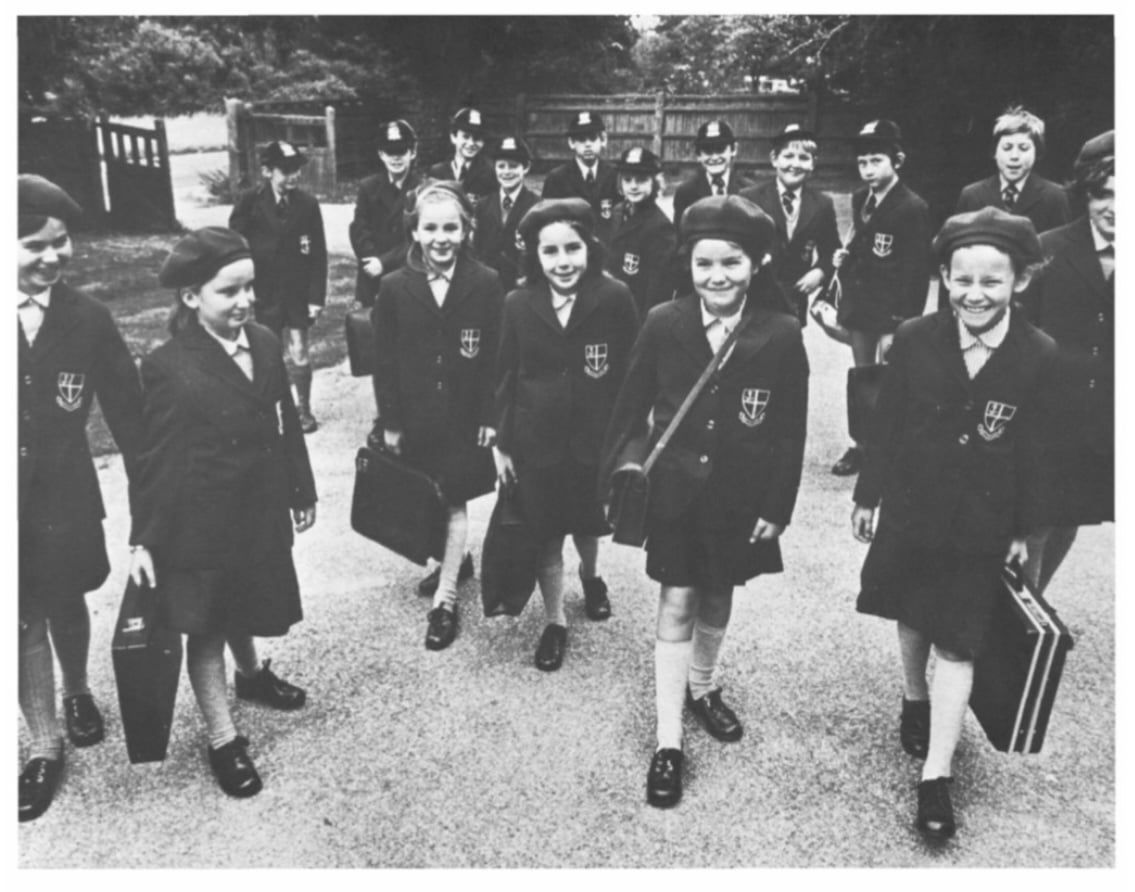
This September marks an important milestone in Kimbolton School’s history: 50 Years of Coeducation. The OKA (Old Kimboltonian’s Association) is very much looking forward to celebrating the first group of girls who joined in 1976, along with the people who opened the doors for them, and the trails they blazed.
The decision to allow girls to attend Kimbolton School has impacted the student body in more ways than we can count. The OKA Office is currently accepting written reflections about coeducation from our alumni.
For those who are interested, please enjoy these recent thoughts from OK Paul Tilley (who left our school in 1980):
“I began my school life in a world of stripey blazers, coloured ties, football boots and an alarming number of school lunch serving plates that were decimated or empty by the time they reached my end of the table. Kimbolton was an all-boys place when I arrived, and for a while the loudest classroom debate was whether the tuck shop should stock more crisps or cream cakes in different shapes. Then the girls arrived, and everything changed — in the best possible way. My younger sister joined in 1977-78, which meant I had front-row seats to the slow, delightful revolution of co-education.
At first the change felt like someone had opened a window in a stuffy room. Conversations became less about who could shout the loudest and more about who could explain an idea clearly enough to persuade someone who thought differently. Suddenly, group projects required listening as much as talking. I learned quickly that an argument that survives being explained to a girl who asks awkward, precise questions is
an argument worth keeping.
Co-education taught me to be curious in a new way. Boys and girls brought different habits to the classroom — not because of some mystical gender rule, but because different expectations had shaped different approaches. Where I might have rushed in with a half-baked plan, a classmate would pause and spot the flaw. Where someone else hesitated, another would try a bold experiment. Those contrasts made our lessons
richer; they forced me to test my ideas, not just repeat them.
There was also a healthy dose of competition — the kind that makes you practise a little longer and read a little wider. Seeing girls excel in subjects I’d always thought were “ours” (maths, for example) was humbling and inspiring. It nudged me out of complacency and into effort. The girls were masters (or mistresses?) at this: they’d quietly outscore the boys in tests and then offer to help revise, which was both infuriating and educational.
Perhaps the most valuable lesson was social. Co-education taught me to explain, to negotiate, and to respect. I learned to work with people whose strengths were different from mine and to appreciate that teamwork is not about dominance but about fit. Those skills — clarity of thought, empathy, adaptability — turned out to be the ones employers and life prize most, long after the exam papers were filed away. And of course there were those parties and off-school discos…
Looking back, I see that co-education didn’t just change the school; it changed me. It made learning noisier, funnier, and more honest. It taught me that the best ideas survive scrutiny from every corner, and that the best learners are those who can listen as well as they speak. If the girls taught me anything in 1978, it was this: learning is better when it’s
shared.”