
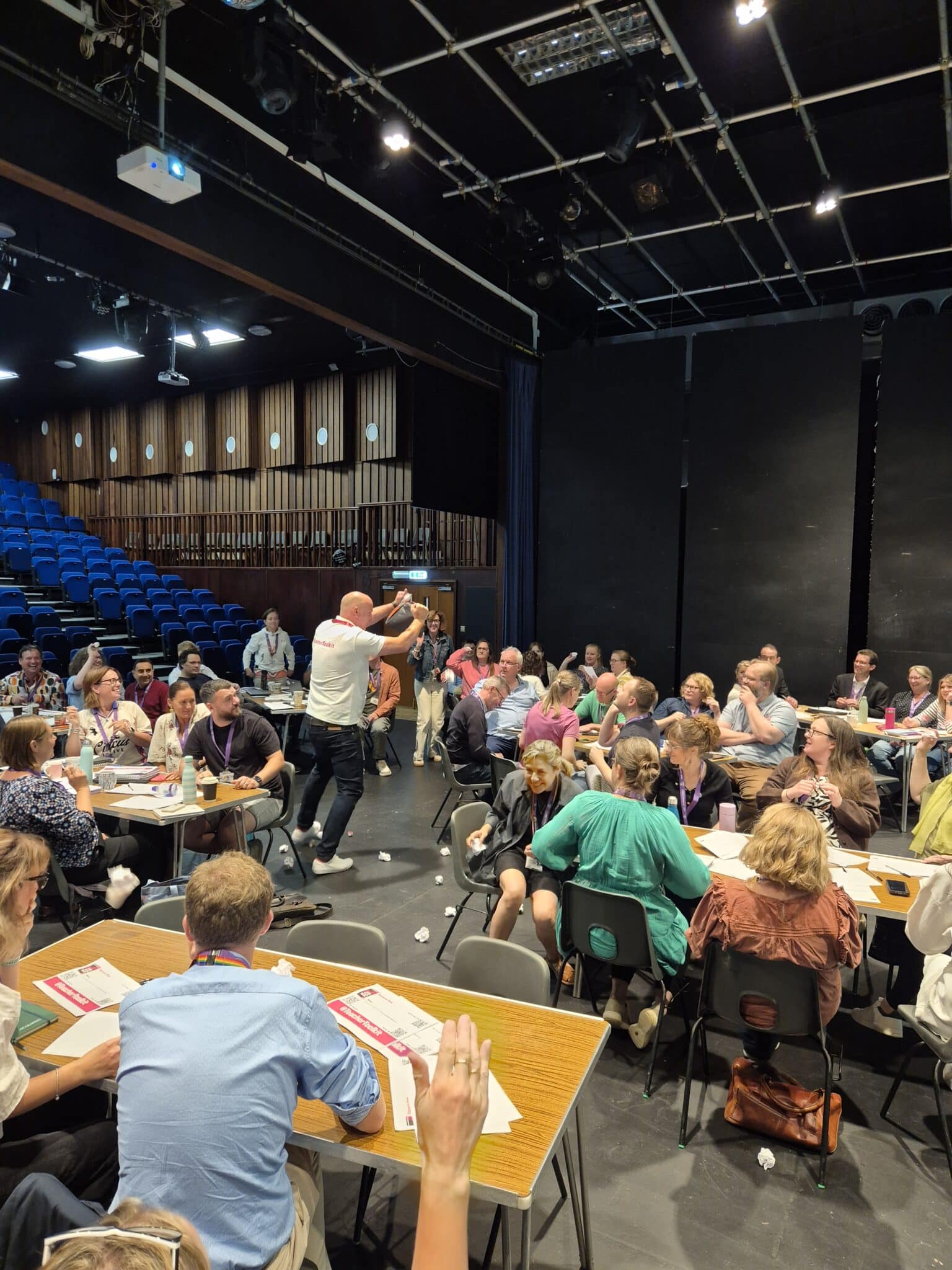
Schools talk a great deal about independent learning. Its most demanding form has a name: heutagogy, the point at which a learner pursues for themselves what they need next rather than waiting to be told. The word was new to me. The ambition was not. It sits at the head of our own Kimbolton Learning DNA as Inquisitive. So it seemed only right that, on the eve of pupils returning to classrooms, the teachers of Kimbolton School should demand it of themselves in an INSET day with Ross McGill.
Ross has spent three decades in some of the most challenging secondary schools in London, first as a teacher and ultimately as a deputy headteacher. Better known across the profession as @TeacherToolkit, he founded one of the most widely read education blogs in the country, has written twelve books on teaching and learning, and was nominated in 2015 for The Sunday Times‘ 500 most influential people in Britain.
He works by provocation: a blunt claim, a pause, and a room of experienced professionals arguing its way towards the evidence. That method only pays in a school where the practice is already strong, because the value lies in the argument rather than the instruction. Our staff spent the morning it interrogating why the things they already do well work, which is a more useful question and a harder one.
Three of those provocations are worth sharing, because each one sharpens something a parent may recognise in their child’s experience of the classroom.
The first was stickability. It is a deceptively simple test: can a pupil recall and use, in six weeks’ time, what they appeared to understand perfectly on Tuesday? A lesson can feel successful yet still leave very little behind. Striving for stickability means building in deliberate spacing across weeks, practising the process of forgetting and retrieving. It is uncomfortable, and that desirable difficulty is precisely what makes long-term recall stronger. We employ this through structured adaptive, and by better understanding how memory works, allowing teachers to reflect on how to best refine a scheme of learning that revisits by design rather than by accident.
We then visited the struggle zone. There is a point, well established in cognitive research, at which work becomes hard enough to demand real thought but not so hard that a pupil disengages. That is where the magic happens. It follows that a lesson in which everything goes smoothly may not be a lesson in which very much has been learnt. Difficulty is planned, embraced, supported and temporary. High challenge is only kind when it is held up by the relationships and the support around it, and the two strands are not in tension. They depend on one another.
Marking came in for the sharpest scrutiny of the day. The quantity of written comments in an exercise book should never be mistaken for the quality of feedback a child receives. Feedback must be meaningful, manageable and motivating. What follows is not less, but feedback which is delivered differently to greater effect: whole-class commentary on the misconceptions, live correction during lessons, and dedicated time in which pupils have space to act upon the advice they are given. A page of red ink has improved nothing if a child never responds to it! That is academic integrity in practice, and it demands something of pupils as well as teachers.
Heutagogy. Most of us would call it staying curious. It is exactly what we hope for in our pupils, and a Sixth Former who can identify the gap in their own understanding and close it has learnt something more durable than any single specification. That habit is rarely taught in a single lesson. It is caught from those daily, ordinary interactions withing a strong and committed learning community This seemed reason enough to have begun the year by practising heutagogy ourselves.