
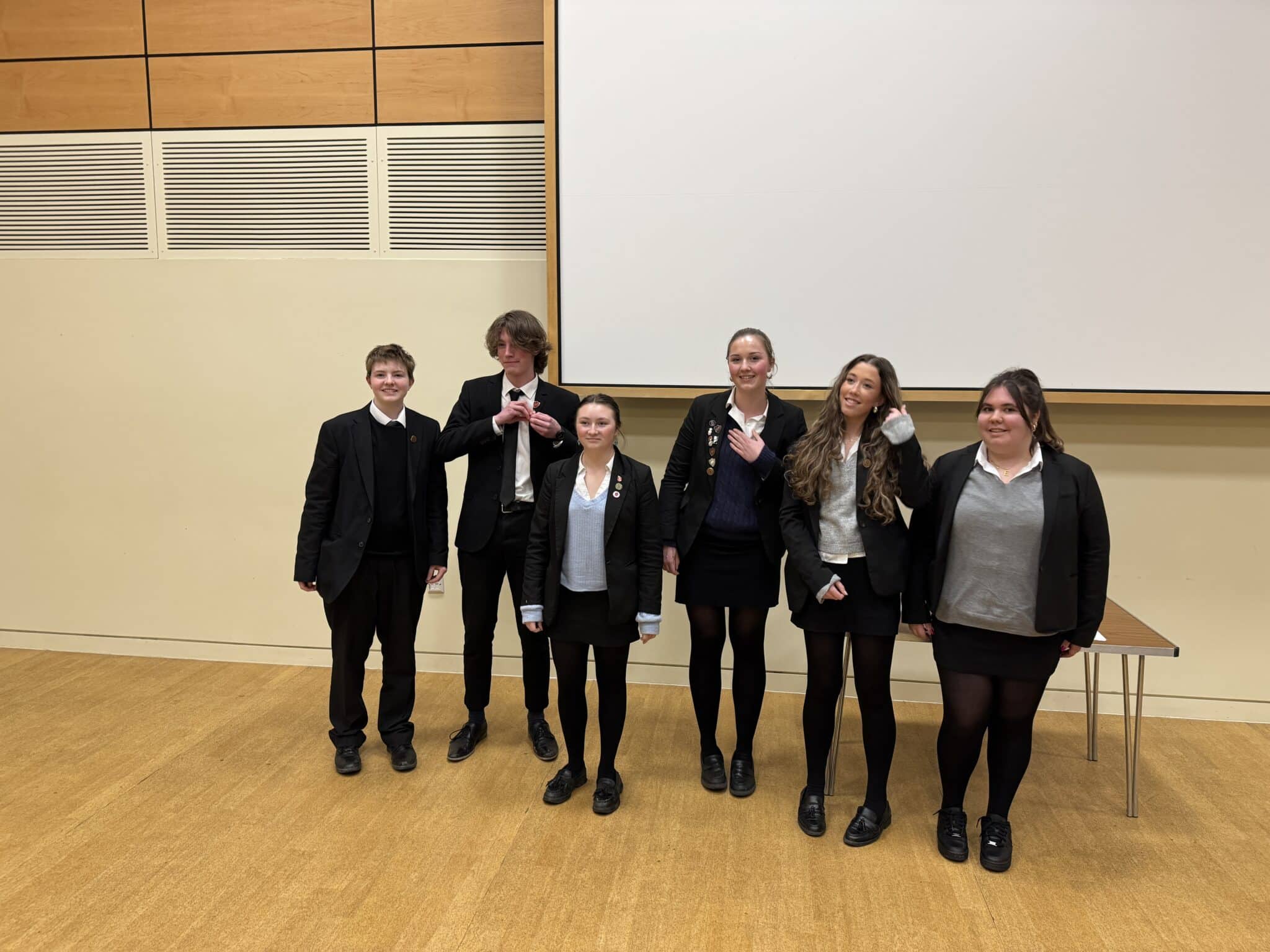
On Tuesday evening, Art Critical & Contextual Studies pupils from the Lower and Upper Sixth delivered a series of thoughtful and well-researched presentations to members of the Manchester Group, as part of their preparation for the Articulation Prize, run by the National Gallery.
With 2026 marking the 300th anniversary of John Vanbrugh’s death, the main focus of the evening was Vanbrugh’s architectural legacy. The talks explored his influence on some of Britain’s most significant historic buildings, alongside the wider artistic and historical context of the period, linking national heritage to Kimbolton’s own architectural story.
The presentations showcased the pupils’ depth of academic enquiry alongside their growing confidence in public speaking. Each talk demonstrated careful research, critical analysis and the ability to communicate complex ideas clearly to an informed external audience.
Louise B. explored the Acropolis frieze, focusing on the extraordinary significance of Jacques Carrey’s sketches. Made just fifteen years before the frieze was destroyed by artillery fire, Carrey’s detailed drawings – produced by an amateur observer rather than a professional artist – unknowingly preserved the only complete visual record of the sculpture. Louise highlighted how the frieze we know today is a composite of original sculpture, restoration, reproduction and historical drawings.
Isabella H. examined the gardens of Kimbolton Castle, analysing how their design was influenced by John Vanbrugh and reflecting broader trends in architectural and landscape thinking of the period.
Eva S. compared Kimbolton Castle with Blenheim Palace, both associated with Vanbrugh’s architectural legacy. She explored how, while both buildings draw on Baroque style and classical features, Kimbolton retained its fortress origins, whereas Blenheim embraced a more theatrical and monumental expression.
Erin B. focused on the remodelling of Kimbolton Castle’s interiors in the early eighteenth century. She explained how changing ideas of comfort and fashion led to interior redesigns by architect James Wyatt, including the introduction of chandeliers, symmetry and classical imagery in the state rooms.
Theo T.C. compared Castle Howard and Kimbolton Castle, outlining Vanbrugh’s unconventional route into architecture. Despite having no formal training, Vanbrugh was commissioned in 1699 by Charles Howard to design Castle Howard. Theo highlighted architectural similarities between the two buildings and considered how Vanbrugh’s background shaped his approach.
Callum Y. presented a wider biographical study of John Vanbrugh’s life, from writing his first play while imprisoned, to his military career, and his later success as a playwright and architect. He also examined the professional and personal challenges Vanbrugh faced during the construction of Blenheim Palace, including being refused permission to visit the building once it was completed.
The evening provided an excellent opportunity for pupils to extend their studies beyond the classroom, engage with an external audience and refine their ability to articulate critical ideas with confidence and authority.