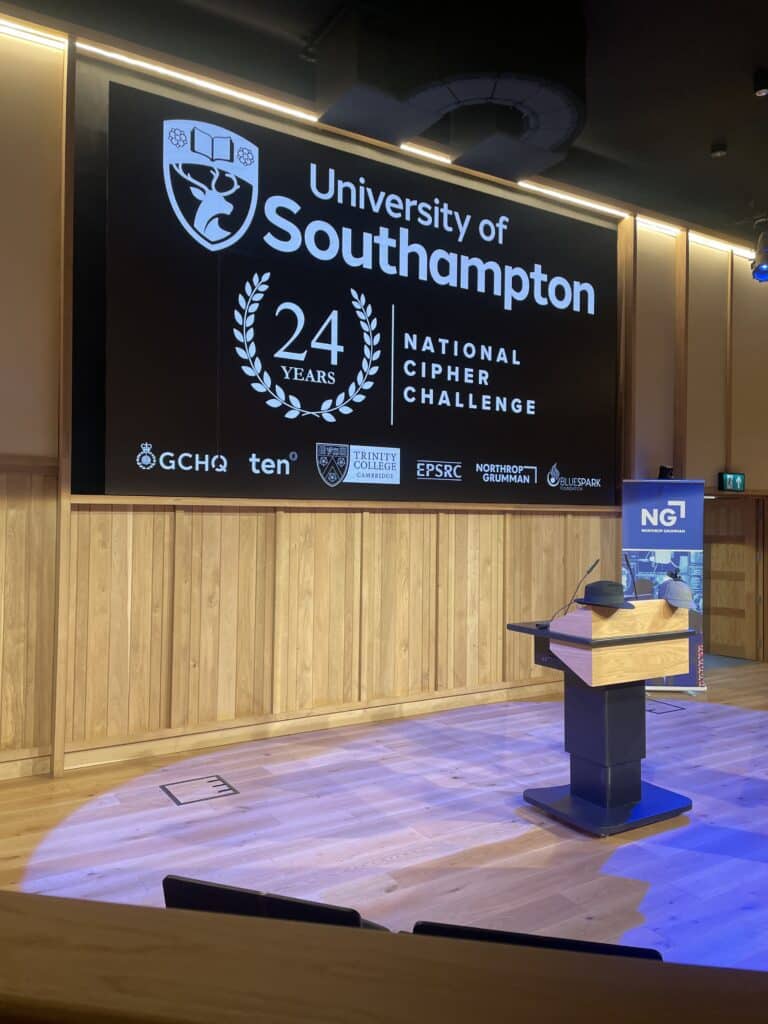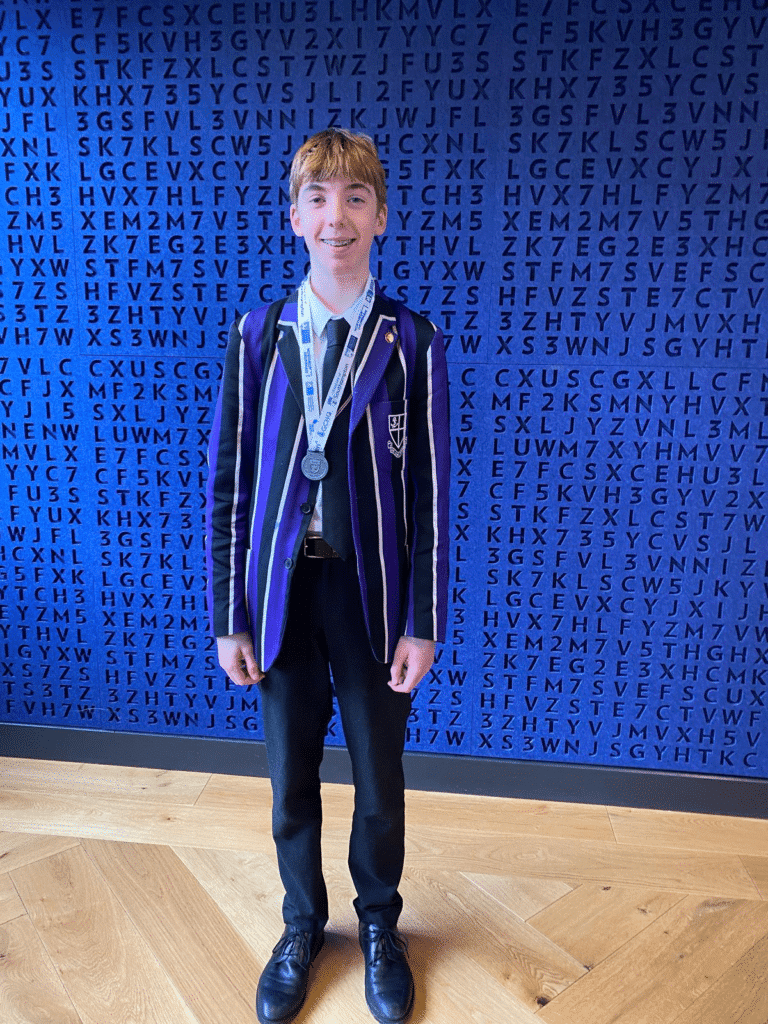

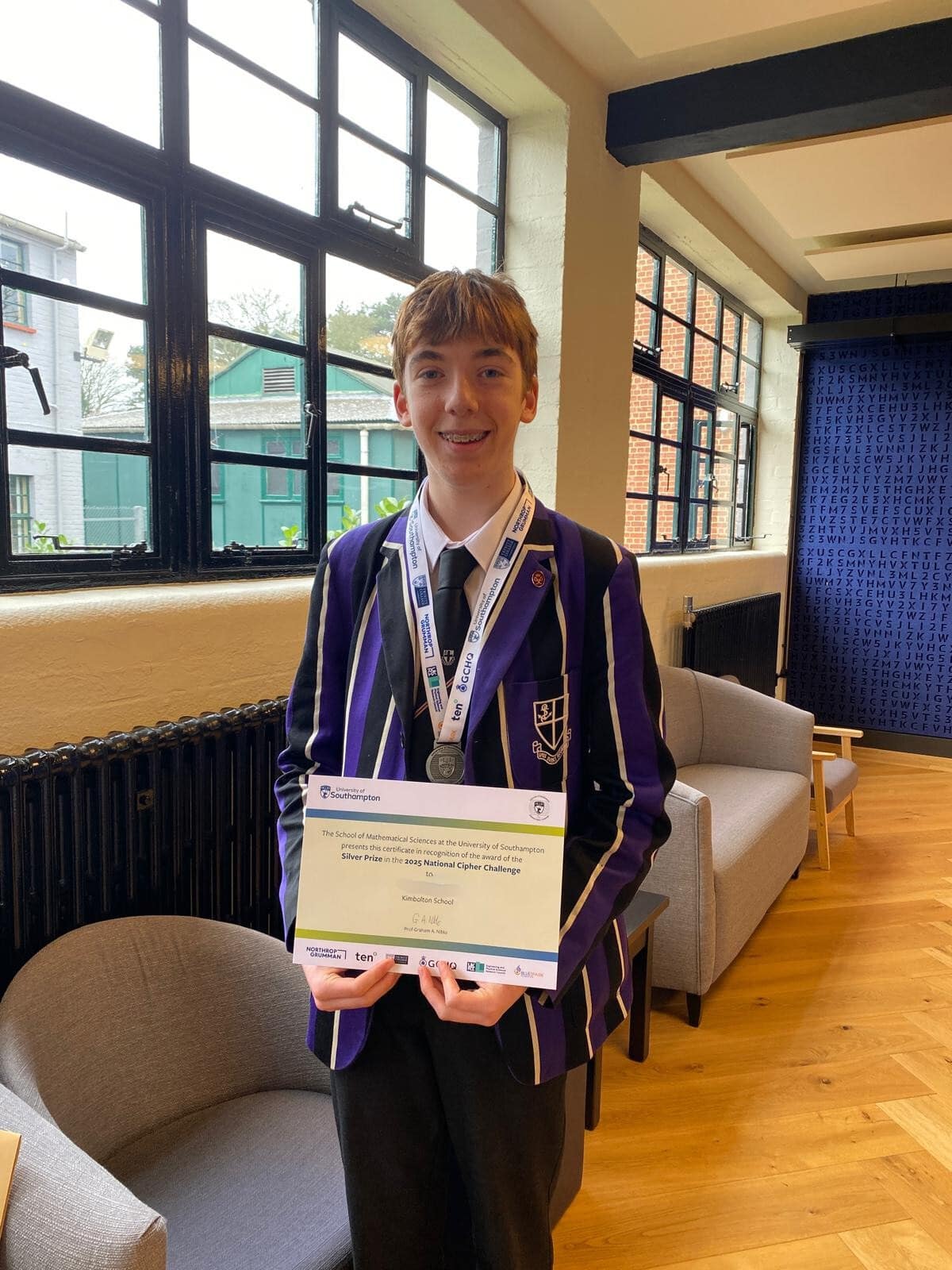
Having completed the National Cipher Challenge last term, and as one of the competitors achieving 100%, Lucas R. was invited to attend National Cipher Challenge Prize Winners event at Bletchley Park. He was awarded the Silver Prize and presented with a silver medal in recognition of his excellent performance in the competition.
Participants in the challenge solved a series of increasingly difficult cryptographic puzzles, registering online and submitting solutions as they progressed; prizes were awarded to those who solved the most challenges accurately and quickly.
Lucas greatly enjoyed the event and the chance to explore topics linked to his passion for Computer Science. Congratulations to Lucas on this fantastic achievement.
Blog by Lucas R.
The National Cipher Challenge was a competition I took part in from the start of September until around Boxing Day. Each week on Thursday at 15:00, participants were given two enciphered plaintexts that we had to decipher using our own programming skills (my chosen method), Excel spreadsheets, or by hand—effectively any method we could come up with, as long as we did not use AI to solve it for us.
Each week, the challenges became harder, ranging from Challenges 1–10A and 10B, and were all based on historical figures in computer science and codebreaking, such as Charles Babbage (who developed an early method for cracking the Vigenère cipher). In addition to solving the ciphers, we also had to complete them within different time periods, with more points awarded for faster solutions.
Up until Challenge 10B, I completed every challenge with 100% accuracy in the quickest time band, managing to stay high on the leaderboard until reaching Challenge 10B, the notoriously difficult final challenge. I spent days trying to crack this cipher and eventually completed it on Boxing Day, after it was released on the 18th of December. Coincidentally, I was on holiday at the time, and the hotel staff looked very confused when I had a pack of cards seemingly scattered randomly across the floor. In the end, I completed it within the middle time band, earning 180 out of 360 points with 100% accuracy. So far, it has been my favourite competition I have entered, and I thoroughly enjoyed the experience.
In February, I was surprised to receive an invitation to Bletchley Park for the prize-giving, where I was awarded a silver prize. We began the day by chatting with other invitees before heading into the park for an in-depth exploration of the lives of the workers at Bletchley, gaining a real sense of their incredible work and feeling immersed in the environment where they operated the Bombe machines to crack the German Enigma cipher.
We then attended talks by Rob Eastaway, an author and mathematician, and “Mike” from GCHQ. They discussed AI—its advantages and disadvantages, its ability to solve complex challenges such as the cipher challenge—and also presented us with some brain teasers to solve ourselves. Afterwards, we moved on to the prize-giving, where awards were presented to teams and individuals from schools across the nation in recognition of their incredible hard work.
I was so inspired by this experience that I went on to create the Cambs Cipher, a similar set of challenges set during the time of the Franco-Prussian War, using military ciphers from the period. I programmed the website and developed it into what it is today, with participants from our school as well as others across Cambridgeshire.
The idea stemmed from a desire to recognise and develop young people’s talents in codebreaking within schools by creating a more localised competition. It has recently gained recognition from the Hunts Post in an article about the competition, and I am currently in the process of featuring it in the Village Bystander.