
Before he transformed the English landscape with sweeping colonnades and monumental façades, Sir John Vanbrugh first made his name under the bright lights of the Restoration stage. Bold and unapologetically provocative, Vanbrugh emerged in the 1690s as one of the most distinctive dramatists of his generation. His plays were filled with scandal and satire – qualities that would later find striking parallels in his architectural work.
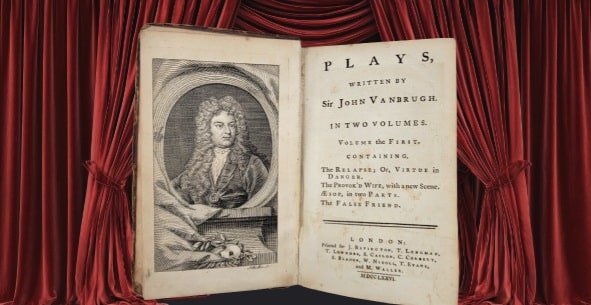
Vanbrugh’s theatrical debut came in 1696 with The Relapse, staged at Drury Lane. Unusually for a first play, it was a sequel to Love’s Last Shift by Colley Cibber. Where Cibber’s comedy offered sentimental moral reform, Vanbrugh responded with biting cynicism. Marital harmony collapses, virtue wavers, and characters manoeuvre with sharp self-interest rather than moral clarity. The subplot, featuring the preening fop Lord Foppington and his famously extravagant wig, revelled in visual comedy and theatrical excess. Even in these early works, Vanbrugh showed a keen understanding of spectacle: costume, staging and comic timing were integral to the drama’s effect.
The following year, Vanbrugh deepened his exploration of flawed humanity in The Provok’d Wife. Here, marriage is depicted not as sacred union but as social contract, and one that can fail. Lady Brute’s sharp assertion that a broken promise dissolves obligation reflects the political anxieties of post-1688 England, where questions of governance, authority and individual liberty were fiercely debated. Vanbrugh’s theatre was not simply entertainment; it was a microcosm of society, exposing hypocrisy and probing the tensions between freedom and control.
These same preoccupations, power, performance, and the choreography of human behaviour, would later surface in Vanbrugh’s architecture. His great houses are inherently theatrical. Processional approaches build anticipation like rising curtains; vast halls function as stages for display; light and shadow heighten emotional impact. Just as his plays resist neat moral endings, his buildings often defy strict classical restraint, favouring movement, contrast and dramatic massing over polite symmetry.
It is no coincidence that the designer of Blenheim and Castle Howard began as a dramatist. Vanbrugh understood that both theatre and architecture shape experience. On stage, he arranged characters to expose society’s tensions; in stone, he arranged space to express power and grandeur. In both forms, he embraced boldness over timidity, spectacle over subtlety.
For Vanbrugh, whether writing dialogue or raising domes, the aim was the same: to move an audience.
With thanks to Dr Annette Rubery for providing the in-depth information on Vanbrugh as Playwright.